
- This event has passed.
Lynne Marsh: after-lived
February 27 6:00 pm – March 1 5:00 pm
Friday, February 27 –Opening Performances 6–9 pm
Saturday, February 28 –Performances 1–5 pm
Sunday, March 1 –Performances 1–3 pm, Conversation 3–5 pm
These poor nymphs of the present, distorted by the endless screens they must pass through before finding themselves in something resembling “the real world.” Unaccustomed to the weight of what we might call reality, they fall out of an infinite space-time into the brutal pull, or rather push, of gravity.
–Hannah Sage Kay, Poor Nymphs Poorer Selves*
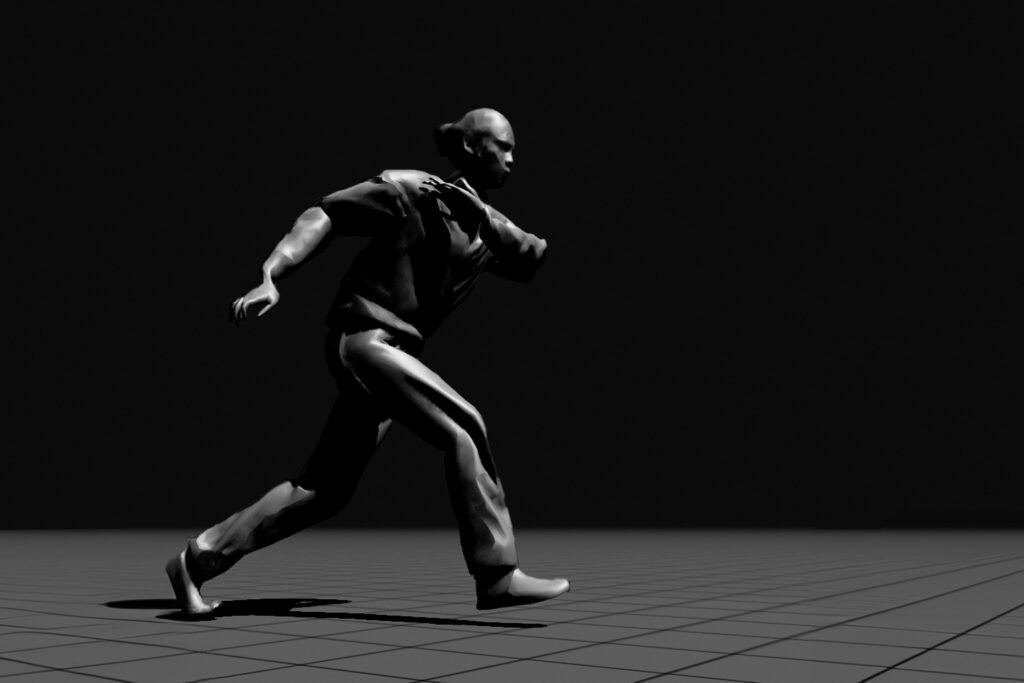
after-lived unfolds over three days at Human Resources Los Angeles as an exhibition-based performance. Performers work through gestures learned from a motion-capture animation archive: they embody, repeat, reorient, and endure them. Each performer trains with an avatar generated from a digital scan of their own body, set in motion as if possessed. What begins as data becomes flesh, altered by the screens it has passed through.
The archive carries its own residue: combat loops, evasions, falls, and impacts. Gestures circulate in a dense image economy, detached from their original conditions and optimized for reuse. Here, however, they meet the weight of gravity. Slowed down and enfleshed, a fall is no longer seamless. Impact registers. Repetition produces strain.
The title after-lived names a condition in which systems persist beyond their declared obsolescence, continuing to operate even after their logic has been exhausted. In this state, gestures survive their contexts. They loop, mutate, and return. The body becomes the site where these loops are absorbed, tested, redirected, and possibly exited.
*excerpt from exhibition text for Standing Death Backward at council_st, June 2025
Lynne Marsh is a Canadian artist based in Los Angeles and Associate Professor at UC Riverside. Her practice questions the status of the image through mediation, technology, and production. Ideas central to Marsh’s research include offstage space, production-in-production, affective and cultural labor, music as a framing device, and the Brechtian revealing of the mechanics of cultural and theatrical production.
Performers
Abriel Gardner (aka bob) is an artist. She has a background in dance and works in many media. She currently lives in New York.
Jobel Medina is a Filipino-American dancer and choreographer based in Los Angeles. His work spans the United States and France, and he has collaborated with artists including Tino Sehgal, Benjamin Millepied, Dimitri Chamblas, Alex Prager, Kim Gordon, Simon McBurney, Shahar Binyamini, Danielle Agami, and Tom Weinberger. His choreography has been presented at institutions such as the Philharmonie de Paris (with LA Dance Project), The Broad, the Museum of Contemporary Art, the Musée d’Orsay, and the Institute of Contemporary Art.
Ryan OByrne is an artist and MFA candidate in Studio Art at The University of California, Riverside. His work antagonizes the compulsive circulation of conventional terms of logic, investing in the poetic potential of neologisms that might interrupt repetitions of violence, extraction, and exploitation. He is a graduate of The Juilliard School’s Drama Division.
Cecilia Slongo is an interdisciplinary artist from Argentina, based in Los Angeles. She investigates the body as an archive and its relationality with the material and non-material realms. Cecilia is currently exploring the intersection of media, corporeality and memory.
In conversation with
Amy Skjerseth is Assistant Professor of Popular Music at University of California, Riverside. She researches media, music, material culture, and technology. Her books Preprogrammed: How Electronic Presets Changed Music and Media (UC Press) and the coedited volume The Routledge Companion to Voice and Identity will be out later this year.
Judith Rodenbeck is an art and cultural historian whose research focuses on intermedial art practices since 1945. She trained at Yale, Columbia, and the Massachusetts College of Art & Design, and is currently a Professor of Media & Cultural Studies at the University of California, Riverside.
Lynne Marsh would like to acknowledge the support of the UC Riverside Center for Ideas and Society and the UC Humanities Research Institute.