- This event has passed.
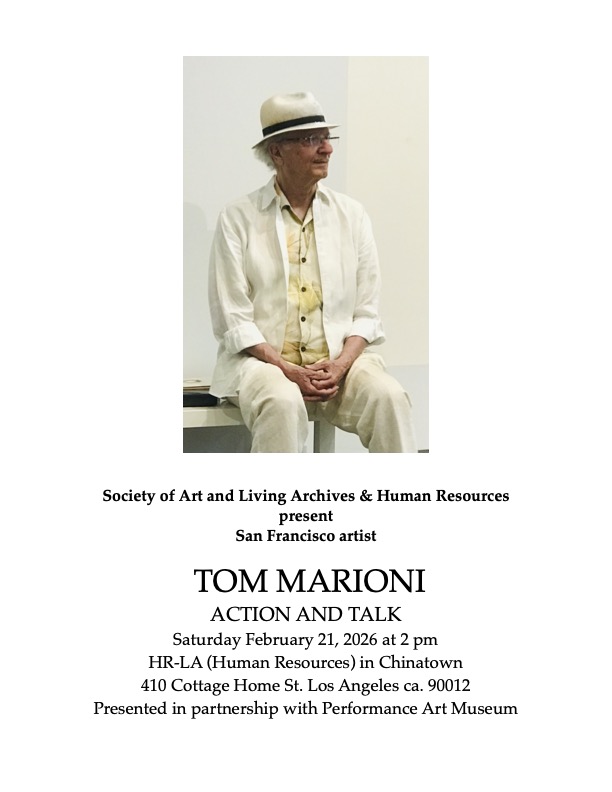
Tom Marioni – ACTION AND TALK
February 21 2:00 pm – 4:00 pm
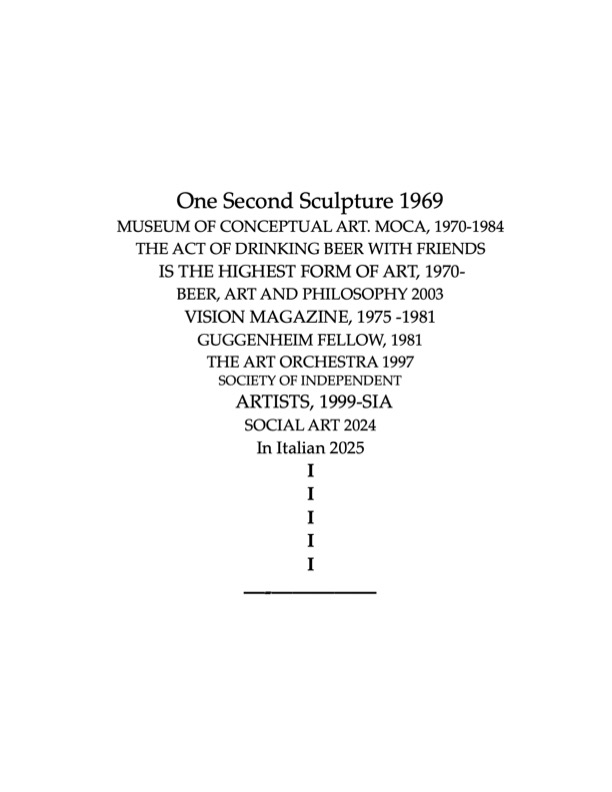
A progenitor of West Coast conceptual art, Tom Marioni will present a critical re-engagement with the ontological foundations of California’s avant-garde. Marioni, the founder of the Museum of Conceptual Art (MOCA) in San Francisco (1970–1984), will perform two definitive “actions” that collapse the boundaries between temporal duration and physical residue: Out of Body Free Hand Circle (on prepared wall), a wall-based manifestation of Zen-influenced persistence, and One Second Sculpture (1969). The latter, described as a “drawing in space,” involves the release of a coiled metal tape measure to produce an instantaneous fusion of sound, line, and gravity.
Marioni’s performative lecture is presented by Society of Art and Living Archives (SALA) and Human Resources Los Angeles (HRLA) and in partnership with the Performance Art Museum (PAM). The project is organized by SALA founder Alberto Cuadros.
Marioni’s deep-rooted connection to the Southern California conceptual art scene includes a significant solo exhibition at the Newport Harbor Art Museum (now OCMA), a survey at the Hammer Museum, and his inclusion in the landmark exhibition Out of Actions at MOCA Los Angeles. Marioni has collaborated with and curated many artists, including Marina Abramović, Chris Burden, John Cage, Terry Fox, Paul Kos, Linda Montano, Bruce Nauman, and Barbara T. Smith. This upcoming performance in Los Angeles is a live archival activation of a transformative period of experimental art in California.
About the Artist
Tom Marioni (b. 1937, Cincinnati, Ohio) is an influential figure in the history of American conceptual art and a primary architect of the West Coast’s “social sculpture” movement. After moving to San Francisco in 1959, Marioni fundamentally challenged the traditional boundaries of the art object, shifting the focus from the production of static things to the creation of “idea-oriented situations.”
In 1970, Marioni founded the Museum of Conceptual Art (MOCA) in San Francisco. Through his work at MOCA and his earlier tenure as curator at the Richmond Art Center (1968–1971), Marioni provided a radical platform for ephemeral, sound-based, and body-oriented “actions” by artists such as Chris Burden, Bruce Nauman, and Terry Fox. Marioni is perhaps most widely recognized for his ongoing social artwork, The Act of Drinking Beer with Friends Is the Highest Form of Art (first staged at the Oakland Museum in 1970). This piece, which involves a weekly salon where the social exchange is the medium and the resulting debris is the “artifact,” has been acquired into the permanent collection of the San Francisco Museum of Modern Art (SFMOMA) and performed globally. Marioni’s work is held in the permanent collections of the Museum of Modern Art (New York), the Centre Pompidou (Paris), and the Stadtische Kunsthalle (Mannheim). He remains a central figure in the San Francisco art community, where he continues to lead the Society of Independent Artists and collaborate with Crown Point Press.
About the Curator
Alberto Cuadros is an artist, curator, and independent art historian based in California, and the founder of SALA (Society of Art and Living Archives). Originally established in 2020 as Society of Art Los Angeles, the organization expanded into San Francisco in 2025. Cuadros’s work through SALA is characterized by a “socially engaging” approach, often using his extensive network of artists and cultural leaders to create immersive experiences that address the current realities of the urban environment.
SALA is a 501(c)(3) nonprofit dedicated to telling the stories of overlooked California art in site-specific exhibitions, talks, salons, and programs.The organization focuses on California’s cultural history, dating back to the 1840s, to connect traditional practices with contemporary creativity. Based in San Francisco, SALA is inspired by the inclusive nature of “salon culture” and aims to bring together art and daily life closer through exhibitions, workshops, city-wide tours, and experimental programming. SALA’s 2026 programming (titled Living Archives: San Francisco) interprets intersectional Bay Area art histories and the specific sites where they unfolded.