
Vital Signals: Early Japanese Video Art and discussion with Glenn Phillips
September 20 2:00 pm – 4:00 pm
CTG, Kohei Ando, Takahiko Iimura, Keigo Yamamoto, Toshio Matsumoto, Video Earth Tokyo, Mako Idemitsu, Nobuhiro Kawanaka, Katsuhiro Yamaguchi, Norio Imai, Hakudo Kobayashi, Tatsuo Kawaguchi, Saburo Muraoka, Keiji Uematsu, Morihiro Wada
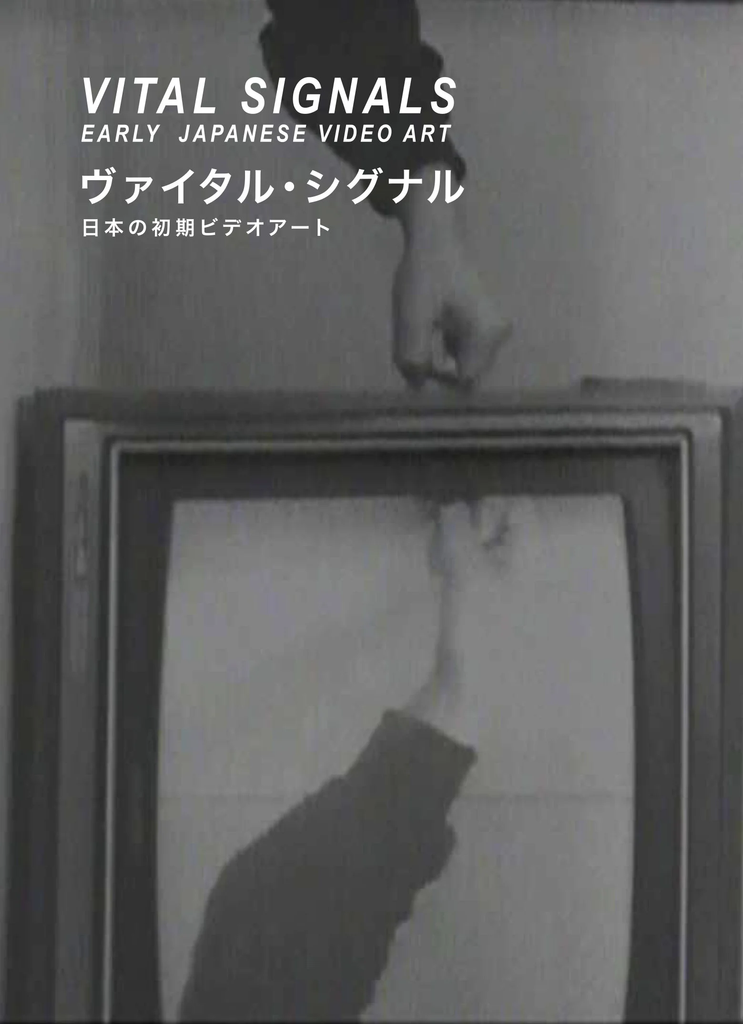
Vital Signals: Early Japanese Video Art, accompanied by a discussion with Glenn Phillips.
Vital Signals is a survey of the vibrant, interdisciplinary video art scene in Japan in the 1960s and ’70s and features sixteen works by fifteen Japanese artists, among them key figures such as Takahiko Iimura, Mako Idemitsu and Toshio Matsumoto. The anthology was produced by Electronic Arts Intermix as a DVD accompanied by a 100-page, bilingual (English and Japanese) catalogue with essays by Barbara London, Glenn Phillips, and Hirofumi Sakamoto. . The Vital Signals is organized in three parts: The Language of Technology, Open Television, and Body Acts. In technical experiments, activist statements, and conceptual performances, Japanese artists of the 1960s and ’70s transformed the intangible—time, gesture, the electronic signal—into rich art-making material. The Vital Signals anthology illuminate this fertile period of creative engagement in Japan.
While early video art from the U.S. and Europe is internationally recognized, the parallel activities of artists working in Japan—the birthplace of the Portapak, the camcorder, and other innovations—are not widely known. The Vital Signals anthology and catalogue emerge from EAI’s touring video exhibition of the same name. Organized by EAI in collaboration with the Yokohama Museum of Art and a team of Japanese curators and scholars, the three-part exhibition program brings together rarely screened early Japanese video alongside seminal American works from the EAI collection. For more information on the Vital Signals touring exhibition, please click here.
Vital Signals was organized and produced by Ann Adachi of EAI. The video programs were curated by Ann Adachi and Yukie Kamiya, Chief Curator, Hiroshima City Museum of Contemporary Art, Hiroshima, Japan, and Hirofumi Sakamoto, Professor, Wakkanai Hokusei Gakuen University, Hokkaido, Japan. Funding for the DVD anthology and catalogue publication was provided by the Japan-US Friendship Commission.
Program of works
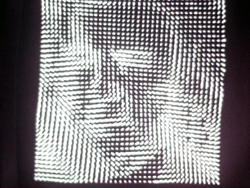
CTG (Computer Technique Group), Computer Movie No. 2, 1969, 8 min, b&w, sound
Computer Movie No. 2 is a CGI animation created in advance of video-editing software. CTG programmed graphics on an IBM computer, filmed the screen with a 16mm camera, and assembled the frames as an animated film.
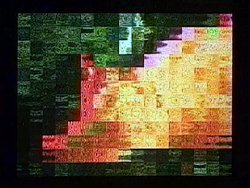
Katsuhiro Yamaguchi, Image Modulator, 1969, 45 sec, color, sound
Yamaguchi writes, “In April 1969, Image Modulator was shown at the Sony Building exhibition Electromagica ’69, using three Trinitron color TV monitors behind a glass that created an optical effect. The glass acted as a literal filter, adding a mosaic effect to the video images.”
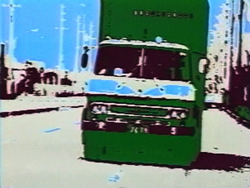
Katsuhiro Yamaguchi, Ooi and Environs, 1977, 1:30 min, color, sound
A video installation using three monitors and mirrors, Ooi and Environs depicts the Tokyo cityscape with electronically modified footage of the city. Aiming to create an interactive environment, images reflected on the mirror shift as audience members move.
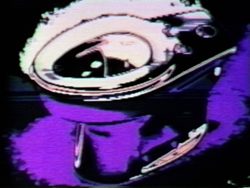
Toshio Matsumoto, Metastasis, 1971, 8 min, color, sound
Writes Matsumoto, “I used the Erekutoro Karapurosesu (Electro Color Processor), which is mainly used in the field of medicine and engineering, to create moving image textures Metastasis, I was interested in layering images of a simple object and its electronically processed abstraction. The electronic abstract image is manipulated in a certain rhythm, depicting an organic process.”

Kohei Ando, Oh! My Mother, 1969, 14 min, color, sound
Writes Ando, “Oh! My Mother was the first work I made using a newly bought 16mm camera I had purchased with the writer Shuji Terayama in Paris. This piece was selected for the Oberhausen International Film Festival. In 1969, there were, of course, no video cameras like ones we see now, and color TVs were only found at broadcast television studios. I had just been employed at the TBS (Tokyo Broadcasting System), and I often snuck into the studios after hours to experiment with the equipment. Oh! My Mother was made using the feedback effect, which is produced by infinitely expanding the image by looping the video.”
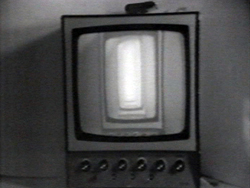
Takahiko Iimura, Camera, Monitor, Frame, 1976, 17:15 min, b&w, sound
Camera, Monitor, Frame is the first installment of Takahiko Iimura’s “Video Semiotics Triptych” (the other two works are Observer/Observed, made in 1975, and Observer/Observed/Observer, made in 1976). The work analyzes the fundamental components of video: the camera, the monitor, and the frame, focusing on the role of each within a system of video as analogous to the functions of vision and speech.
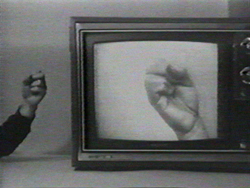
Keigo Yamamoto, Hand No. 2, 1976, 7:50 min, b&w, silent
Using video technology as an extension of his body, Yamamoto interacts with a pre-recorded image of his hand displayed on a monitor.
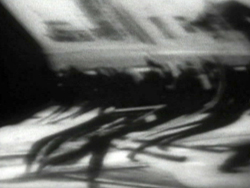
Toshio Matsumoto, Magnetic Scramble, 1968, 30 sec, b&w, silent
Magnetic Scramble is the first video work by Toshio Matsumoto. Here, the artist manipulates television images (of student demonstrations against the U.S.-Japan Security Pact) by holding a magnetic coil next to the monitor. Matsumoto later incorporated this piece into a scene of his film Funeral Parade of Roses (1969).
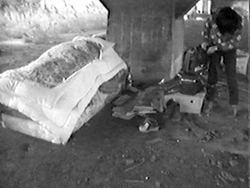
Video Earth Tokyo, Under A Bridge, 1974, 13 min, b&w, sound
In this tape, Ko Nakajima and Video Earth Tokyo interview a homeless man. The subject is initially angry and frustrated, but gradually opens up and shares stories about his life. Under A Bridge was later broadcast on cable television.
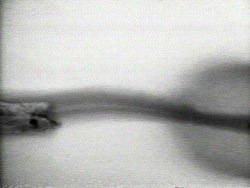
Mako Idemitsu, What a Woman Made, 1973, 10:50 min, b&w, sound
In Idemitsu’s seminal feminist video, the image of a tampon swirling in a toilet bowl slowly appears, as the artist speaks about the troubling roles, responsibilities and expectations of women in a clinical tone. Minimal in composition, this is a candid critique of the treatment of women in Japanese society.
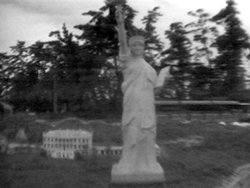
Nobuhiro Kawanaka, Kick The World, 1974, 15 min, b&w, sound
Writes Kawanaka, “Video is a medium of image as well as sound. Walking on a gravel road with a camera, the crunch sound is captured in real time. Such [an] observation seems obvious, but as a filmmaker, the ability to record sound in real time was very new to me. Referencing a can-kicking game I played as a child, I followed the rolling can and recorded the resonant sounds of the can hitting the ground.”
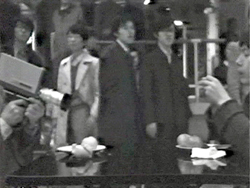
Katsuhiro Yamaguchi, Eat, 1972, 1:30 min, b&w, sound
Katsuhiro Yamaguchi and Hakudo Kobayashi presented the video performance Eat at Video Hiroba’s first exhibition, Video Communication DO IT YOURSELF KIT. Two performers sit at a table. One records the other eating; then they switch roles. The live video feed of the performance was displayed on a monitor in the exhibition space.
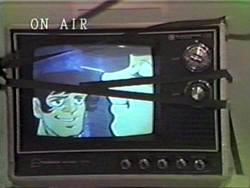
Norio Imai, Digest of Video Performance, 1978-1983, 1978-1983, 15:35 min, color, sound
Writes Imai, “As a photographer during the 1970s, my interest in capturing time led me to explore the video medium. After utilizing video in two or three works, I saw a similarity between videotape and an ancient scroll, in that they both capture a story of our time. I started using physical videotape as a metaphorical representation of time, rolling out the magnetic tape from right to left, representing a narrative from beginning to end.”
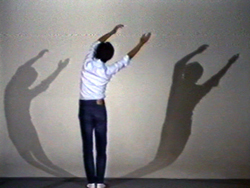
Hakudo Kobayashi, Lapse Communication, 1972-1980, 16 min, color, sound
Writes Kobayashi, “In 1972 I started a series of participatory performances where the first person performs an ambiguous action in front of a recording camera; the next person watches the recorded footage and imitates the action in front of a recording camera; the third person repeats the same procedure using the second person’s video recording, and so on. Within the repetition of recording and action, the original gesture is transformed by the participants’ misunderstanding, interpretation, and memory.”
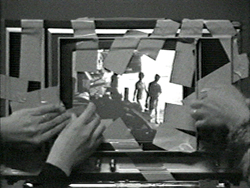
Tatsuo Kawaguchi, Saburo Muraoka, Keiji Uematsu, Image of Image-Seeing, 1973, 11:20 min, b&w, sound
A collaborative performance, Image of Seeing–Seeinginvestigates the meaning of television watching. This work was created for television broadcast on the Nippon Broadcasting Corporation’s program “Hyōgo no jikan” (Hyōgo Time).
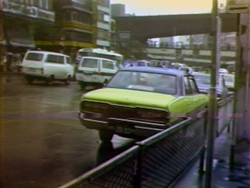
Morihiro Wada, The Recognition Construction: Hyojyutsu (Against Application or Mimesis) 1975, 20 min, color, sound
A member of the collective Video Hiroba, Morihiro Wada also used video in his solo projects. In The Recognition Construction, each subject entering the frame is identified by a narrator, while the video camera slowly rotates. As the rotation speeds up the identification becomes more difficult, and the objects ultimately become “indecipherable.”